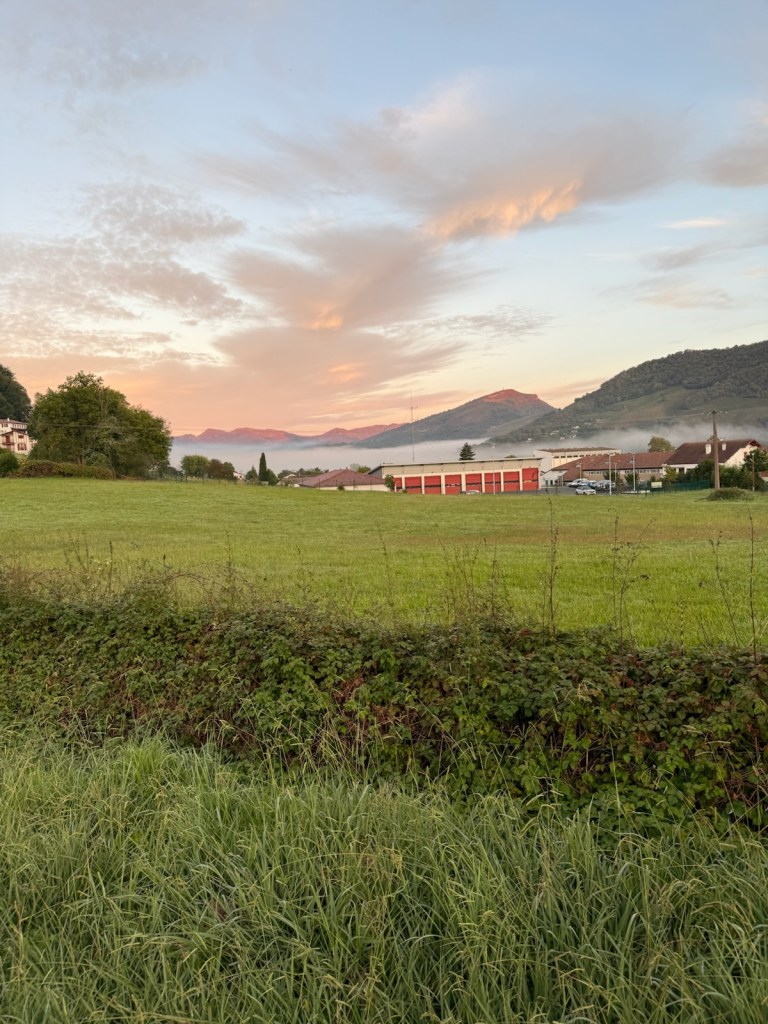
We’re back in Park City after 13 days of hiking El Camino de Santiago from St. Jean Pied-de-Port in France, over the Pyrenees, down through parts of the Basque Country, and across Asturia and Galicia to Santiago de Compostela. My phone was acting up, and I wasn’t able to take any pictures, and I decided not to do a daily blog.
Mike loved the trek with my niece Lauren and her husband James. I wasn’t as thrilled, but made it to Santiago nonetheless. I took one day off due to extremely tight calves. and my cousin Mikel, a physical therapist, came to my rescue, bringing a portable TENS machine to Pamplona with his beautiful wife Ainara. We had a wonderful visit while we waited for Lauren, James, and Mike to meet us. We also had a fun visit with some of my other cousins: Ismael, Luken, Charo and her husband Ismael, their 2 sons Guillermo and Martin, and Mikel’s daughter Lucia. Charo’s husband Ismael walked with us for 2 days. We took a wrong turn and managed to find ourselves on a narrow trail with lots of sticker bushes. We finally made it back to the Camino by walking through a recently harvested wheat field.
We had beautiful, sunny weather for most of our trek, very unusual for that time of year. The rain finally caught up to us… or maybe WE finally caught up to the rain? one day before our final walk into Santiago. When we arrived in Santiago, the sun came out, and we happily shared a bottle of Champagne to celebrate another [partial] Camino.
My niece Lauren is a professional photographer, and I am so very grateful that she captured this journey!
Enjoy the pictures from St. Jean Pied-de-Port to Logroño, a brief stop in Leon, and Sarria to Santiago de Compostela.
Full disclosure: I employed ChatGPT to populate some of these blogs to save time. I edited and deleted about half and added my own experiences.
While many visit Saint-Jean-Pied-de-Port for the Camino, the town itself is a cultural treasure. Basque heritage is evident everywhere—from the unique language (Euskara) spoken by locals, to the vibrant festivals, traditional music, and folk dances. I loved being among “my people” (Basques), and took every opportunity to tell the locals we met about my Basque family.
Gastronomy is another highlight. Pilgrims and tourists alike feast on hearty Basque specialties: garbure (a robust soup of cabbage, beans, and ham), trout from the nearby streams, sheep’s milk cheese, freshly baked gateaux Basques, and regional wines. We had an amazing Lubino (Sea Bass) dinner at a wonderful Basque restaurant in town.
Pilgrim Services and Preparation
Saint-Jean-Pied-de-Port is exceptionally well-equipped to assist pilgrims. The pilgrim office provides maps, advice on routes, weather updates, and stamps for the indispensable “credencial” or pilgrimage passport. Numerous albergues, guesthouses, and hotels cater to every budget and need, often filling up quickly in the high season. We stayed at a charming hotel, the appropriately named “Hotel Central”, in the center of town.
Shops stock hiking gear, first-aid supplies, and the all-important scallop shell—a centuries-old symbol of the Camino. The shops and pilgrim office open very early!
Stories and Spiritual Connections
Each year, thousands of people embark from Saint-Jean-Pied-de-Port for reasons as varied as the pilgrims themselves. Some are motivated by faith or tradition, others by a search for meaning, healing, or simply the love of walking. Along the Camino, conversations flow easily; language barriers melt away in the warmth of shared experience.
The Camino is as much an inner journey as a physical one. Many recount moments of revelation and transformation amid the mountains and meadows, the laughter and the blisters. In Saint-Jean-Pied-de-Port, this sense of possibility and hope is tangible, woven into the very fabric of the town.
Practical Tips for Pilgrims
Timing: The main Camino season runs from spring to autumn, with the busiest months being May, June, and September. Early spring and late autumn can be quieter but riskier weather-wise, especially in the mountains.
Preparation: The first stage is strenuous. Adequate training, good footwear, layered clothing, and a light backpack are essential.
Reservations: Book accommodation in advance during peak season, as Saint-Jean’s lodgings fill up quickly.
Health: Take care to acclimate to the altitude, stay hydrated, and treat any early blisters to prevent complications later.
Community: Embrace the camaraderie. The Camino spirit is one of kindness, generosity, and mutual support.
The Camino Francés: Beginning the Pilgrimage
Saint-Jean-Pied-de-Port’s significance lies not just in its beauty but in its role as the “zero kilometer” of this epic journey. Pilgrims, identifiable by their scallop shells and sturdy boots, gather here to obtain their pilgrim credentials, often visiting the pilgrim office on Rue de la Citadelle. The volunteers in the pilgrim office were very helpful, and gave us some tips on how to stay on the path. Only problem: we assumed the Camino would start uphill from the pilgrim office…
The Legendary First Stage: Over the Pyrenees
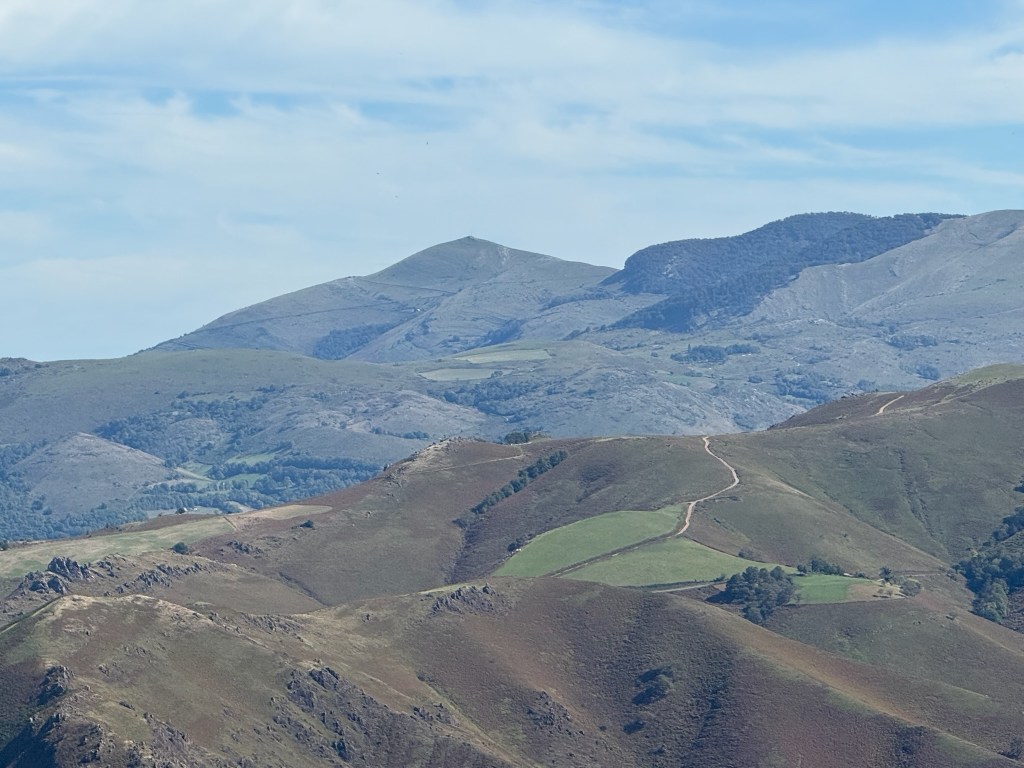
One of the most iconic and challenging sections of the entire Camino Francés is the very first stage: crossing the Pyrenees from Saint-Jean-Pied-de-Port to Roncesvalles in Spain. This demanding 25-kilometer (15.5-mile) trek ascends more than 1,200 meters (3280 feet), winding through lush forests, high mountain pastures, and offering panoramic vistas that are both breathtaking and humbling.
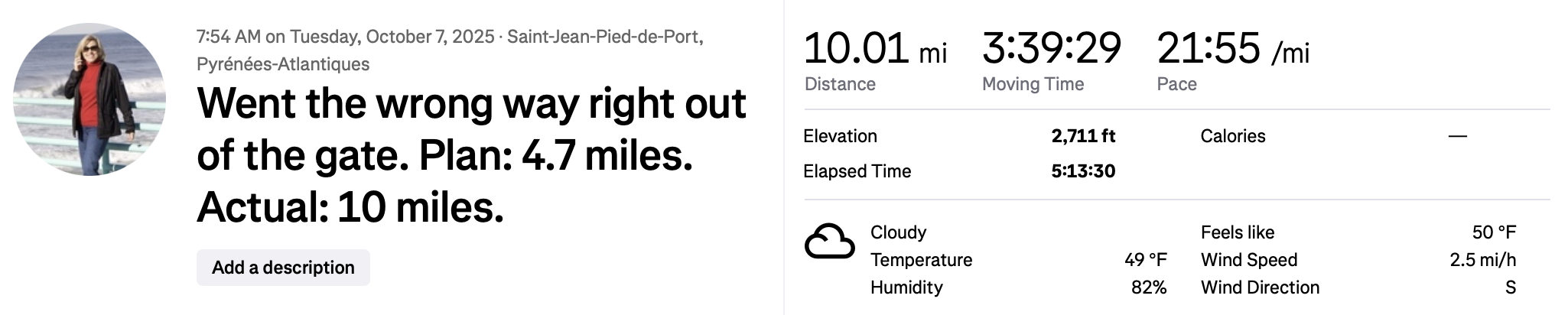
Originally, we planned to give ourselves a day to deal with our jet lag and do this initial stage tomorrow. Luckily, we changed our minds and decided to break the stage into 2 days, walking to Orisson, only about 4.7 miles, today, and completing the stage tomorrow. We started out immediately going the wrong way, wondering why we didn’t see any other pilgrims walking. Instead of walking only 4.7 miles, we walked 10. Instead of an elevation gain of 1900 feet, we climbed 2710. Tomorrow will be even harder, but we’ll pay closer attention to the route, hopefully making the 10+ miles in 5.5 hours.
Starting in October instead of August like we’ve done on our prior Caminos, we started our trek at 7:45 instead of 6:00, thinking we’d be back in St. Jean by noon. Ha! From my Strava account:
Last year, we walked from Viana do Castelo, a cute village north of Porto, to Santiago de Compostela on the Camino Portuguese, coastal route, with our niece and her husband. It was our third Camino, having walked half of the Camino del Norte and full Primitivo routes in 2017, and the full Camino del Norte route in 2022. When Lauren and James said they’d like to do another Camino after the Portuguese route, Mike immediately asked, “When are we going?” I wasn’t quite as enthusiastic, and for 6 months I thought I’d sit this one out.
Willow and I are so very excited about training….
Then, Mike was diagnosed with squamous cell carcinoma, an aggressive type of skin cancer, on the top of his head. The cancer was very deep, but it was removed in March, and after 4 weeks of radiation treatments, the oncologist is confident that he’ll be fine. During that time, Mike told me that he really wanted me to accompany him to Spain. So, we’ve been training on the hills in Park City for the past few months.
This time, we’ll be walking about 200 miles of the Camino Francés (French Way), the most popular of the various Camino de Santiago routes. Starting in Saint-Jean-Pied-de-Port, whose name means “Saint John at the Foot of the Pass”, a picturesque town in the French Basque Country. The full Camino traverses about 500 miles across northern Spain, culminating, as most of the Caminos do, at the Cathedral in Santiago de Compostela, where the remains of Saint James are believed to rest. We’ll walk 8 days to Logroño, and then skip ahead to Sarria to walk the final 5 days to Santiago.
In his book A Million Steps, Kurt Koontz wrote that the first third of this 500-mile journey focuses on the “physical” aspects; the second on the “emotional”; and the third on the “spiritual”. I found that to be true on our first 2 Caminos. Our third Camino was an abbreviated pilgrimage, only 125 miles. I never got past the physical, even on our last day.
We arrived after a few uneventful flights to Paris and Biarritz. This town is charming, with dams and waterfalls on the Nives River. There are a lot of peregrinos (pilgrims) in town, all getting ready for their Caminos.
Our first Camino was an extremely hard and rewarding experience. We were 7 years younger than we are now, and we were very disciplined, training for months for our 500-mile walk on The Strand in Manhattan Beach, at sea level, with no hills except for an occasional walk from our house to the beach.
Two years ago, we trained on hiking trails at 7000-to-8000 feet above sea level, along hilly trails and streets with our 2 Labrador Retrievers Sterling and Willow. Training was great, but I never found shoes that made my feet happy for the 15-mile days on the Camino.
This spring, I lucked out. The guy at REI listened to my tale of woe and description of the terrain in Portugal, and very patiently brought out multiple pairs of trail runners. Finally, my feet were happy! Then I started experiencing excruciating pain in my toes. Turned out to be Morton’s Neuroma, which has been calmed down by topical steroidal cream.
Back on the trails, I took a few falls, tripping over rocks or roots, and then just last week I didn’t notice a step at a restaurant, resulting in a twisted ankle and bruised knee.
We have 1 day left before we leave; I never did meet my goal of walking 10 to 12 miles. 8.5 was my longest hike… I have a feeling that I’ll regret not training harder on those 15-and 17-mile days on the Camino.
Mike, on the other hand, is once again fully prepared, adding extra hiking miles with the dogs each day, happy as a clam with shoes that he orders online that fit perfectly.




 Souper Power